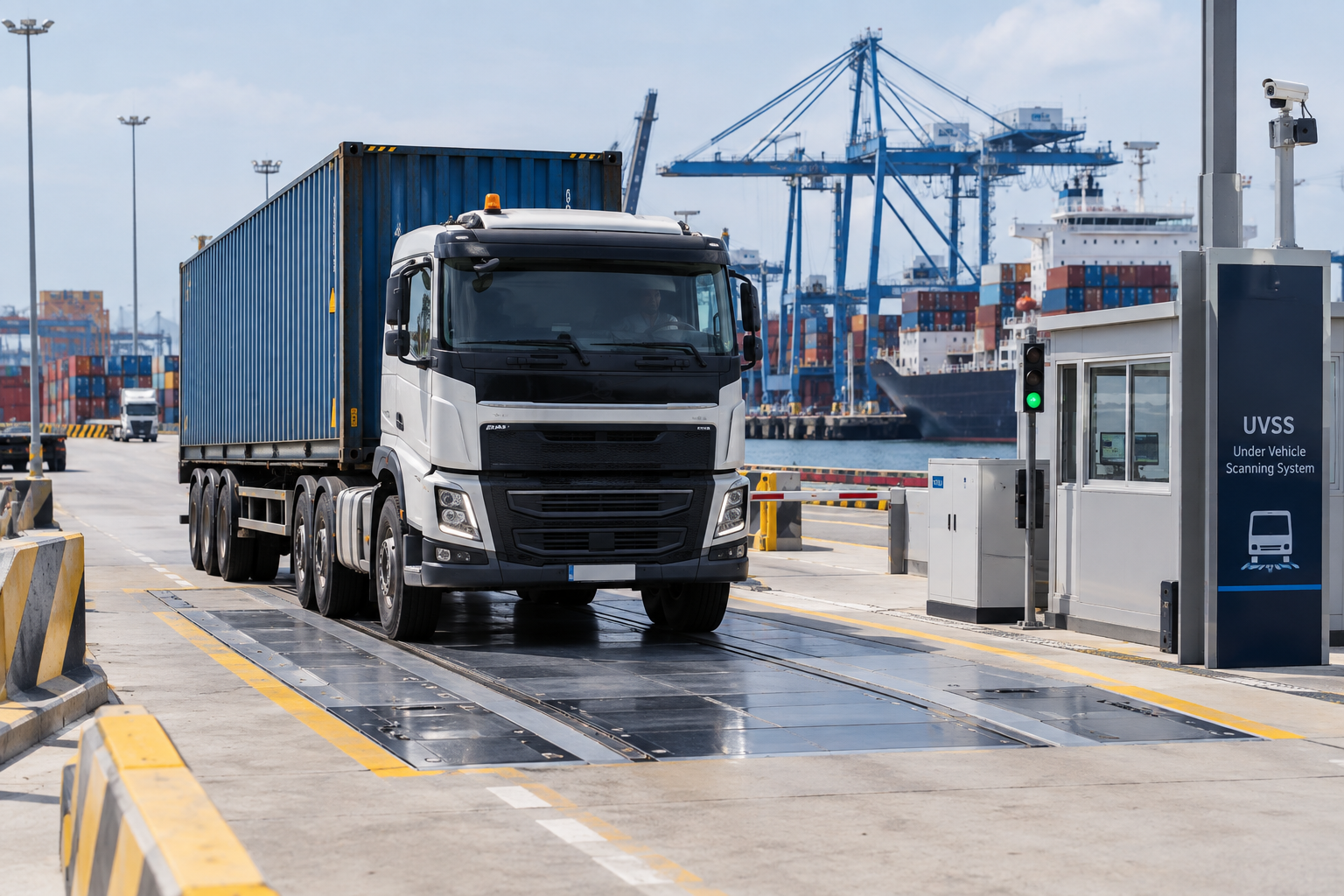
Maritime gateways represent the lifeblood of international commerce, handling over eighty percent of global trade. Container terminals, roll-on/roll-off (Ro-Ro) docks, and cruise ship terminals process tens of thousands of vehicles, chassis, and heavy freight transports every single day. However, this massive volume and economic density make maritime perimeters prime targets for transnational crime, contraband smuggling, human trafficking, and vehicle-borne terrorist threats. To maintain compliance with stringent international maritime standards like the ISPS Code (International Ship and Port Facility Security Code), port authorities must enforce rigorous access control without stalling supply chain momentum. Relying on manual inspection mirrors or slow physical spot-checks is no longer viable in high-throughput environments. Instead, implementing an automated, high-definition under vehicle scanner for ports and seaports has become an indispensable requirement for securing critical maritime boundaries.
At UVSS, as an industry-leading reseller of elite perimeter checkpoint surveillance and cargo screening technologies, we supply top-tier hardware and integrated software tailored specifically to harsh maritime environments. In this technical procurement guide, we examine why a specialized under vehicle scanner for ports and seaports is critical for 24/7 terminal security and how automated undercarriage screening transforms intermodal throughput.
The Harsh Operational Realities of Port Security Checkpoints
Maritime terminals operate under conditions far more demanding than standard commercial facilities. An under vehicle scanner for ports must overcome specific operational hurdles:
- Relentless Heavy-Duty Axle Loads: Hundreds of multi-axle drayage trucks, terminal tractors, and heavily loaded freight containers roll across gate lanes continuously. Fragile consumer-grade systems will warp and fail under this mechanical punishment.
- Corrosive Marine Environments: Salt spray, airborne humidity, standing seawater, diesel exhaust, and chemical washdowns accelerate corrosion. A sub-standard scanning system will degrade rapidly.
- Severe Turnaround Bottlenecks: Every second wasted inspecting a vehicle creates a compounding traffic queue. When terminal gates back up, logistics operators face detention fees, vessel loading schedules slip, and cargo dwell times increase.
- Vast Structural Blind Spots: Commercial semi-trailers, tanker chassis, and heavy haulers possess complex, shadowed undercarriages with dozens of compartments, cross-members, and toolboxes where illegal narcotics, unmanifested weapons, or stowaways can be concealed.
By deploying an automated, industrial-grade under vehicle scanner for ports and seaports, facility directors replace sluggish, subjective manual checks with rapid, objective digital surveillance.
How an Under Vehicle Scanner for Ports and Seaports Operates Under Heavy Traffic
Modern checkpoint systems are built to convert real-time vehicle movement into actionable intelligence without requiring vehicles to stop dead in the gate lane.
┌───────────────────────────────────────────────────────────┐
│     PORT CHECKPOINT INTEGRATED SCREENING WORKFLOW         │
├───────────────────────────────────────────────────────────┤
│  1. Inbound freight truck triggers loop/radar sensors     │
│  2. High-speed line-scan camera captures continuous chassis│
│  3. Shadowless LED flood arrays illuminate structural gaps │
│  4. ANPR camera links container/license plates to profile │
│  5. AI change detection cross-references database baseline│
│  6. Security console renders full HD scan in <3 seconds   │
└───────────────────────────────────────────────────────────┘
When an inbound truck drives over an under vehicle scanner for ports and seaports, high-intensity LED illuminators instantly engage to wash out deep shadows cast by fuel tanks and axles. As the vehicle passes over the scanning pit at speeds up to 30 km/h, specialized digital line-scan or stereoscopic 3D cameras capture thousands of high-resolution digital frames per second.
The software stitches these frames into a seamless, distortion-free composite view of the entire chassis. By integrating an under vehicle scanner for ports and seaports with Automated License Plate Recognition (ALPR/ANPR) and Optical Character Recognition (OCR) for shipping container codes, terminal operators receive a consolidated, time-stamped digital security profile for every freight unit entering the maritime zone.
Key Technical Features to Demand in Port-Grade Scanning Systems
Selecting the right checkpoint hardware requires looking beyond basic resolution figures. When procuring an under vehicle scanner for ports and seaports, your engineering and security directors must demand the following commercial-grade capabilities:
1. Extreme Axle Load Capacities (Up to 40-50 Tonnes)
Ports handle the heaviest road vehicles in the transport sector. The top-plate housing of an under vehicle scanner for ports and seaports must be crafted from high-tensile structural steel or aircraft-grade aluminium capable of withstanding repetitive axle loads of 40 to 50 metric tonnes. This ensures years of reliable operation beneath fully loaded shipping trailers without structural deformation.
2. IP68 Submersible Enclosures & Salt-Fog Protection
Water accumulation is an everyday reality in port access lanes due to sea spray, storm runoffs, and high groundwater tables. An enterprise under vehicle scanner for ports and seaports must feature a certified IP68 water- and dust-tight rating. Furthermore, the unit must incorporate internal bilge pumps, heated optical glass to prevent condensation/frosting, and internal temperature management to withstand maritime humidity and temperature extremes.
3. AI-Driven Anomaly and Foreign Object Detection
With hundreds of trucks clearing the gate hourly, security guards can easily succumb to visual fatigue. A leading-edge under vehicle scanner for ports and seaports incorporates Artificial Intelligence (AI) and machine learning algorithms. The software automatically highlights foreign objects—such as magnetized contraband boxes, suspicious retrofitted compartments, or severed security seals—by comparing live scans against manufacturer baselines or prior clean scans of the fleet.
Installation Architectures: Fixed vs. Portable Deployments
Because no two maritime terminals share identical gate infrastructure, an under vehicle scanner for ports and seaports is engineered in two primary mechanical layouts:
- Fixed (Flush-Mounted) Gate Scanners: These units are permanently cast into a shallow civil trench in the roadway, sitting completely flush with the tarmac. Ideal for high-density primary terminal gates, Ro-Ro ferry boarding lanes, and customs inspection plazas, a fixed under vehicle scanner for ports and seaports provides an unobtrusive, zero-impact surface that endures non-stop heavy traffic for years.
- Portable (Surface-Mounted) Scanners: Consisting of heavy-duty, low-profile modular drive-over ramps, a portable under vehicle scanner for ports and seaports can be assembled in minutes without asphalt excavation. This setup is indispensable for temporary customs checkpoints, seasonal cruise terminal surges, or mobile tactical interdiction units operating along vast wharf perimeters.
Maximizing Port Compliance and ROI
For terminal directors, customs commissioners, and port authority CFOs, an under vehicle scanner for ports and seaports represents a rapid return on investment.
By automating undercarriage screening, your facility can:
- Accelerate Gate Turnaround Times: Processing an entire vehicle in less than 3 seconds eliminates gate congestion and slashes costly truck queue idling.
- Comply with International Mandates: Meet the rigorous requirements of the ISPS Code, C-TPAT (Customs-Trade Partnership Against Terrorism), and WCO SAFE Framework with unalterable, searchable digital archives.
- Deter Contraband and Theft: A visible, automated under vehicle scanner for ports and seaports acts as a powerful deterrent against smuggling syndicates and unauthorized internal access.
Why Choose UVSS as Your Specialized Reseller Partner?
Navigating the procurement of critical port security systems is a multifaceted undertaking. At UVSS, we are not merely an equipment vendor; we are technical advisors dedicated to hardening sensitive infrastructure. We source exclusively from proven, globally vetted manufacturers to ensure that every under vehicle scanner for ports and seaports we supply delivers exceptional uptime in punishing coastal environments.
When you partner with UVSS, you gain end-to-end support, including:
- Detailed site surveys and lane geometry engineering.
- Civil works consultation for recessed drainage and power delivery.
- Flawless integration with existing Terminal Operating Systems (TOS), CCTV, and gate barriers.
- Continuous technical maintenance agreements and rapid-response parts replacement.
Secure Your Waterfront Boundary with UVSS
The integrity of global maritime supply chains depends on rigorous perimeter protection. Leaving the undercarriage of freight haulers and port vehicles uninspected creates an open avenue for high-stakes security breaches. Upgrading your checkpoint infrastructure with an enterprise under vehicle scanner for ports and seaports is the proven way to eliminate physical blind spots, protect maritime personnel, and keep commerce flowing safely.
Ready to modernize your terminal gates? Contact the technical team at UVSS today to request a comprehensive site evaluation, book a live system demonstration, and find the perfect under vehicle scanner for ports and seaports to protect your maritime infrastructure.
Leave a Reply