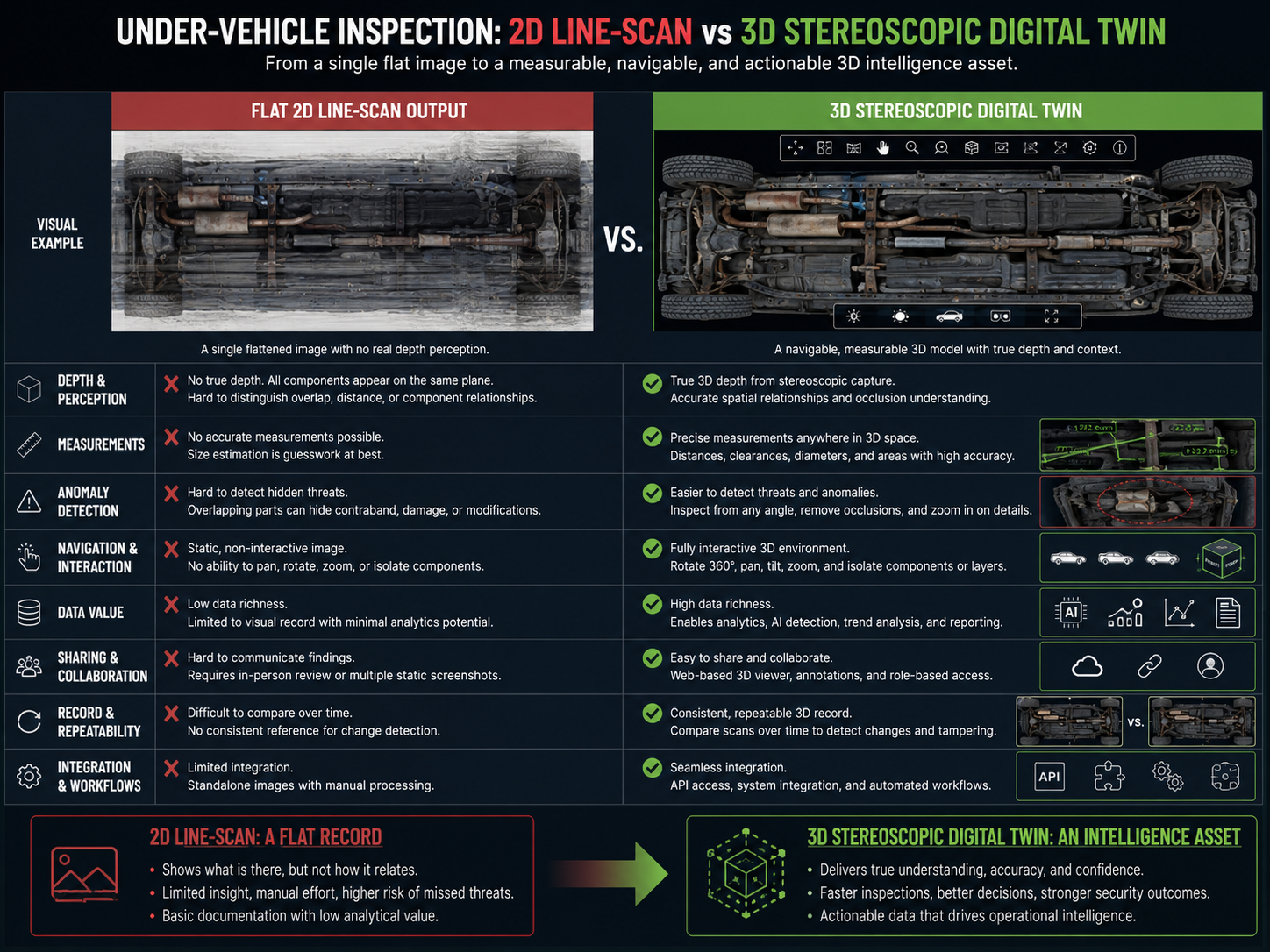
When it comes to securing a high-risk facility—be it a military checkpoint, an international airport, or a corporate data center—the undercarriage of a vehicle remains one of the most critical vulnerabilities. For years, security teams relied on manual mirrors, but today’s threat landscape requires digital speed and automation. As procurement managers and security heads look to upgrade their entry points, two questions dominate the conversation: “What is the uvss scanner price?” and “Should we invest in a 2d vs 3d under vehicle scanner?”
At UVSS, as a premier global reseller of perimeter protection hardware, we believe that an informed buyer is a secure buyer. Navigating the uvss scanner price landscape isn’t just about finding the lowest number on a quote; it is about understanding how different technological capabilities impact your total cost of ownership (TCO) and your facility’s safety. In this comprehensive guide, we will break down the true drivers of market pricing and analyze the core differences between a 2d vs 3d under vehicle scanner.
Understanding the Spectrum of the UVSS Scanner Price
When you begin requesting quotes for security infrastructure, you will quickly notice that the uvss scanner price can vary wildly. A entry-level portable unit might cost a few thousand pounds, while a fully integrated, automated military-grade system can run into tens of thousands.
This variance exists because a uvss scanner price is not determined by the camera alone. Instead, the final cost is a combination of physical ruggedness, software capabilities, and structural installation needs.
The primary factors influencing the uvss scanner price include:
- Civil Engineering Requirements: Flush-mounted permanent systems require road excavation, drainage installation, and concrete work. This structural integration will naturally increase the initial uvss scanner price compared to a surface-mounted, portable ramp system.
- Environmental Protection Rating: Systems engineered to withstand harsh environments—such as freezing winters or scorching desert heat—utilize IP68-rated stainless steel housings and integrated heating/cooling units, which shift the uvss scanner price upward.
- Throughput Speed Capabilities: High-speed checkpoints require line-scan cameras that can capture clear images at speeds up to 30 km/h. The processing power needed to stitch these images instantly impacts the final system cost.
Technological Showdown: 2D vs 3D Under Vehicle Scanner
The biggest architectural choice you will make during procurement involves selecting the imaging style. When analyzing a 2d vs 3d under vehicle scanner, the difference isn’t just cosmetic—it fundamentally changes how your security team identifies hidden threats.
The 2D Scanner: Standard Digital Surveillance
A traditional 2D system uses a linear optical camera to capture slices of the undercarriage as the car drives over it, creating a single, flat composite image.
- The Advantage: A lower initial uvss scanner price. It is a reliable upgrade from hand-held mirrors and provides a clean digital record of entry.
- The Disadvantage: Flat images lack depth. If a weapon or a tracking device is tucked deep inside a wheel well or behind the exhaust manifold, the shadows in a 2D image can completely obscure the threat.
The 3D Scanner: The Next-Generation Digital Twin
A 3D system, such as our advanced stereoscopic units, uses multi-angled sensor arrays to capture structural depth. It builds a complete three-dimensional model of the underbody.
- The Advantage: In the debate of a 2d vs 3d under vehicle scanner, 3D wins on security every time. It eliminates blind spots by allowing operators to rotate the image digitally, seeing “around” pipes and structural beams.
- The Disadvantage: A 3D architecture commands a higher premium, which is reflected in the initial uvss scanner price.
Why the 2D vs 3D Under Vehicle Scanner Choice Dictates Your ROI
For a facility manager, looking solely at the upfront uvss scanner price can be a costly mistake. If you purchase a cheaper 2D system but require your guards to manually inspect flagged anomalies because of bad lighting or shadows, you haven’t actually automated your checkpoint. You’ve simply moved the bottleneck.
When you invest the extra capital into a 2d vs 3d under vehicle scanner platform that utilizes 3D technology, you are unlocking advanced automatic threat detection software. Because the software understands the depth profile of a vehicle, it can automatically flag foreign objects—such as a magnetic box attached to the frame—without requiring a guard to spot it manually. The reduction in human error and faster vehicle processing times mean the higher uvss scanner price pays for itself over a multi-year lifecycle.
Low-Difficulty LSI Features to Consider Before Purchase
To ensure your system integrates flawlessly with your existing security booth, look closely at these secondary system specifications, which can subtly alter your total uvss scanner price:
- Automatic License Plate Recognition (ALPR): Linking the undercarriage scan to a specific license plate creates a searchable database.
- Driver Face Cameras: Capturing both the driver’s identity and the car’s structural profile simultaneously provides total situational awareness.
- LED Illumination Matrix: Ensure the system utilizes heavy-duty LED arrays that don’t burn out easily, as replacing lighting components can add to your long-term maintenance costs.
Why Procure Your Scanner Through UVSS?
As a dedicated reseller of the world’s leading vehicle inspection technologies, UVSS doesn’t believe in selling you more technology than you actually need. We look at your daily vehicle volume, your site topology, and your specific threat level to find the ideal point on the uvss scanner price curve.
Whether your facility is perfectly suited for a cost-effective 2D portable unit for temporary events, or you require a permanent installation of a premium 2d vs 3d under vehicle scanner with AI automation, our team provides the engineering support to make the rollout a success. We manage the vendor relationships, handle the technical commissioning, and provide the ongoing maintenance training that keeps your checkpoint running smoothly.
Conclusion: Future-Proofing Your Entry Points
Perimeter defense is only as strong as its weakest link. Leaving the underside of a delivery van or employee vehicle unchecked is a risk that modern operations simply cannot afford. While the initial uvss scanner price is an important budgetary consideration, it must be weighed against the immense cost of a physical breach.
Understanding the operational differences of a 2d vs 3d under vehicle scanner allows you to make a strategic decision that aligns with your organization’s risk profile.
Ready to get an accurate quote for your facility? Contact the team at UVSS today. Let us provide you with a transparent breakdown of the uvss scanner price for your project and help you choose the best technology to secure your perimeter for 2026 and beyond.
Leave a Reply