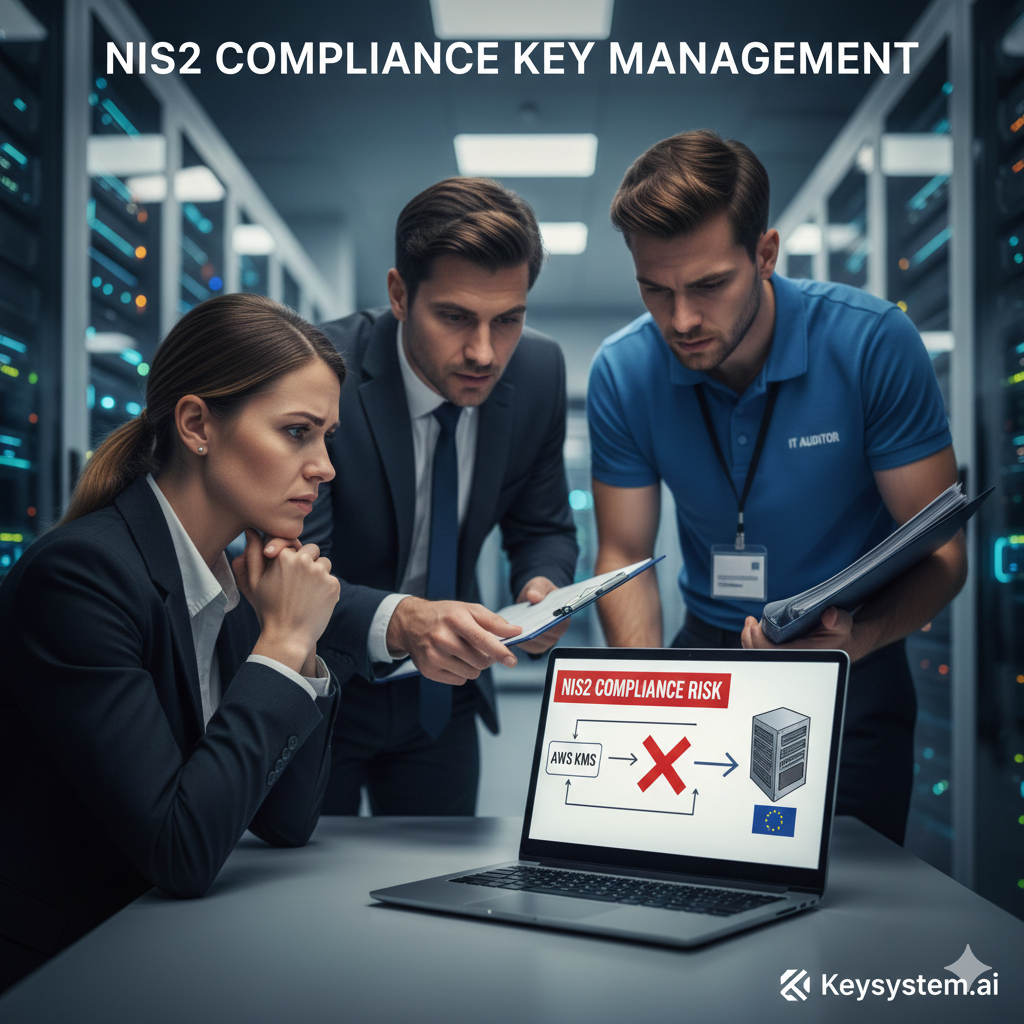
The clock is ticking for European entities and their global partners. With the implementation of the NIS2 Directive, the bar for security supply chains and cryptographic hygiene has been raised to an unprecedented level. If your organization falls under the scope of “Essential” or “Important” entities, your current encryption strategy is about to face its toughest test yet.
For many, the default choice has been Amazon Web Services’ Key Management Service (KMS). It is convenient, highly integrated, and “good enough” for standard cloud operations. However, as auditors begin to sharpen their pencils for the first wave of 2026 assessments, a worrying trend is emerging: true NIS2 compliance key management requires levels of sovereignty and control that native cloud tools simply may not provide out of the box.
At Keysystem, we act as a specialized reseller for the world’s most robust security hardware and software. We provide the cryptographic “brains” that ensure your audit doesn’t end in a massive fine.
The NIS2 Shift: From “Best Effort” to “Total Accountability”
NIS2 isn’t just a minor update; it is a complete overhaul. It mandates that organizations take a risk-based approach to security, with a specific focus on encryption and the lifecycle of cryptographic keys.
The fundamental issue with relying solely on native tools like AWS KMS is the concept of Sovereignty. Under NIS2, you are responsible for the entire lifecycle of your data. If your keys are generated, stored, and managed within the same infrastructure as your data, you are creating a “single point of failure” that auditors are increasingly flagging. This is why many firms are now scouting for AWS KMS alternatives that offer a true separation of duties through dedicated NIS2 compliance key management protocols.
3 Reasons AWS KMS Could Be Your Audit Achilles’ Heel
1. The Jurisdiction Jigsaw (Sovereignty)
NIS2 places a heavy emphasis on European data sovereignty. While AWS has “European Sovereignty” regions, the underlying technology is still subject to international legal frameworks like the U.S. Cloud Act. For a high-stakes enterprise encryption audit, having your keys potentially accessible by a non-EU entity is a significant red flag. A compliant NIS2 compliance key management strategy often requires an “External Key Manager” (EKM) where the keys never leave a physical HSM located on European soil.
2. Lack of Multi-Cloud Transparency
Most modern enterprises are multi-cloud. If you use AWS KMS for your S3 buckets but have other data in Azure or on-premise, your “key sprawl” becomes an auditor’s nightmare. NIS2 demands centralized control. Managing fragmented keys across different cloud providers makes it nearly impossible to prove a unified security posture during an audit. Implementing a centralized NIS2 compliance key management system allows you to manage all environments from one secure vault.
3. The “Black Box” Problem
AWS KMS is a multi-tenant service. While it is highly secure, you do not have exclusive control over the hardware. In the debate of Cloud HSM vs KMS, a Cloud HSM—like the ones we resell from Thales or Fortanix—provides a dedicated environment that is yours alone. Auditors prefer dedicated hardware because it removes the “noisy neighbor” and provider-access risks, fulfilling the stricter requirements for NIS2 compliance key management.
The Strategic Shift: Evaluating AWS KMS Alternatives
If the goal is to pass your audit with flying colors, you need to look at AWS KMS alternatives that provide platform-agnostic control. As a reseller, we see the highest success rates with systems that offer:
- Bring Your Own Key (BYOK): Allowing you to generate keys in your own environment and export them to the cloud.
- Hold Your Own Key (HYOK): This is the gold standard for NIS2 compliance key management, where the cloud provider can never see the key, even during the encryption process.
- Centralized Secrets Management: A single pane of glass to manage AWS, Azure, Google Cloud, and on-premise keys simultaneously.
Cloud HSM vs KMS: Which Does NIS2 Prefer?
When we consult with clients, the question of Cloud HSM vs KMS is the most frequent.
- KMS is a software-defined service. It’s fast and cheap but offers less physical proof of security for high-risk data.
- Cloud HSM (Hardware Security Module) is a physical piece of hardware.
For the purposes of achieving NIS2 compliance key management, the Cloud HSM approach is significantly stronger. It provides a tamper-evident physical boundary. In an enterprise encryption audit, being able to show that your keys exist in a FIPS-certified hardware environment—independent of the cloud provider’s general software layer—is a massive win for your compliance team.
The Reseller Advantage: Why Procurement Matters More Than Installation
At Keysystem, we focus on the procurement and licensing of these advanced systems. We often hear from companies that are hesitant to move away from AWS KMS because they think the alternatives are too hard to set up.
Here is the truth: Modern NIS2 compliance key management tools are designed for the DevOps era.
- We provide the license: You get the enterprise-grade software (like HashiCorp Vault or Fortanix).
- You maintain control: Because we aren’t an installation firm, we don’t have backdoors into your system. We provide the tools; your IT team (or trusted local contractor) handles the implementation.
- Cost Efficiency: By buying the hardware and licenses through a reseller like us, you avoid the high “managed service” markups that cloud providers charge for their HSM modules.
Preparing for Your 2026 Enterprise Encryption Audit
If you want to ensure your NIS2 compliance key management is up to par, follow this 3-step checklist:
- Inventory Your Keys: Where are they stored? If 100% of them are in AWS, you have a sovereignty risk.
- Test for Portability: If you had to leave AWS tomorrow, would your keys go with you? If not, you are “locked in,” which NIS2 views as a business continuity risk.
- Upgrade to Dedicated Hardware: Consider shifting your “Root of Trust” from a software KMS to a dedicated Cloud HSM.
Conclusion: Don’t Let Convenience Become a Liability
AWS KMS is a fantastic tool for developers, but it was never designed to be a “Compliance Shield” for the strict mandates of the NIS2 Directive. As the enterprise encryption audit season approaches, the companies that succeed will be those that took control of their own cryptographic destiny by investing in robust NIS2 compliance key management.
Whether you are looking for AWS KMS alternatives or trying to settle the Cloud HSM vs KMS debate for your board of directors, the team at Keysystem is ready to help you source the technology that keeps you compliant, secure, and sovereign.
Leave a Reply