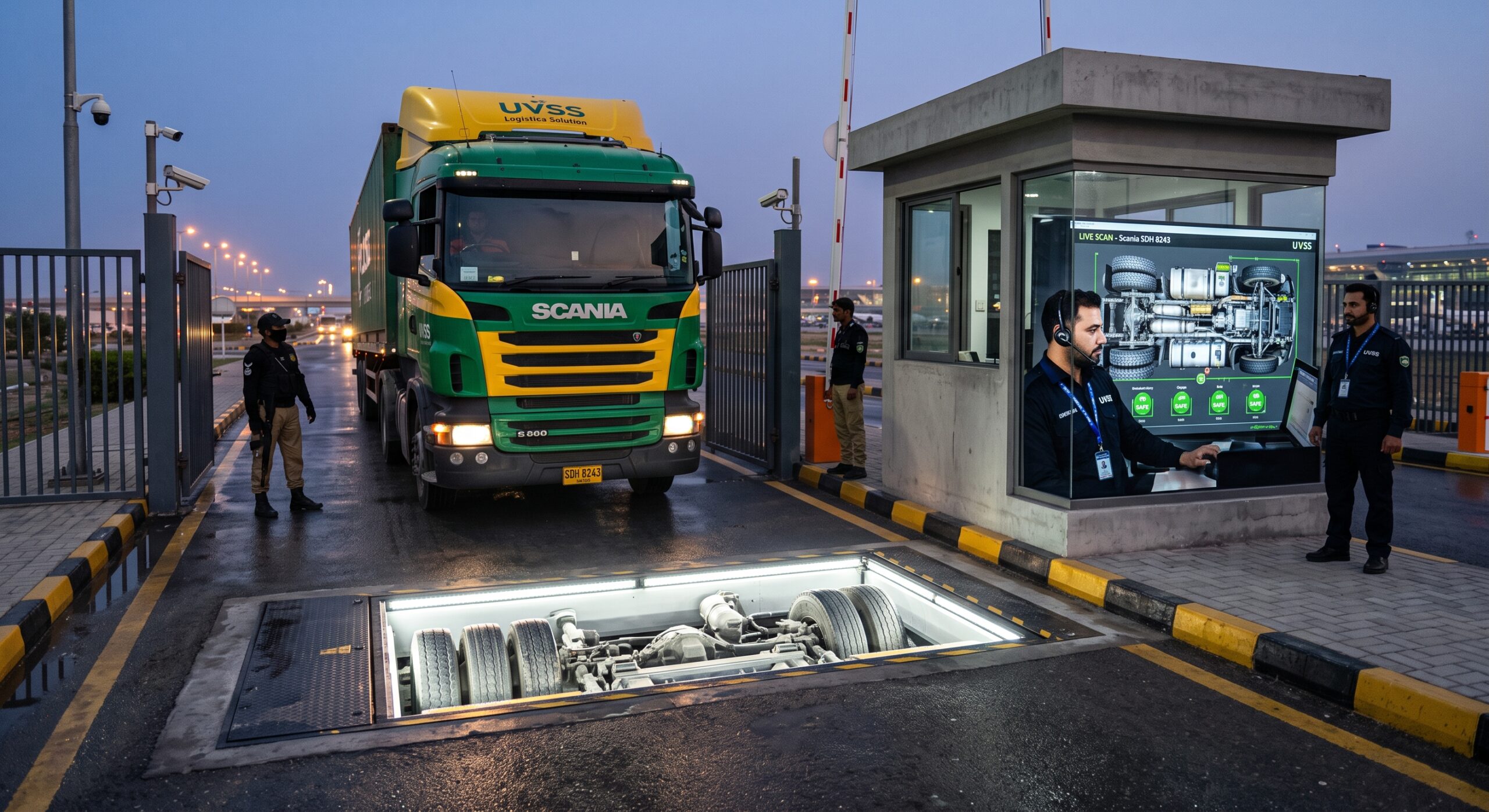
Perimeter defense for high-consequence facilities—ranging from government installations and military bases to corporate campuses, border crossings, and major transport hubs—demands a zero-tolerance approach to vulnerabilities. Security teams routinely deploy biometric access control, surveillance towers, and automated barrier systems to secure entry corridors. Yet, one of the most critical physical vulnerabilities exists mere inches off the asphalt: the undercarriage of arriving vehicles. Because it is naturally obscured, the underbody provides an ideal cavity for concealing contraband, unauthorized tracking hardware, narcotics, or vehicle-borne improvised explosive devices (VBIEDs).
For decades, facility managers relied on guards wielding handheld inspection mirrors on rolling sticks. In the modern threat environment of 2026, this legacy method represents a severe operational liability. It is slow, highly subjective, dangerous for guards, and rife with human error. To bridge this critical gap, physical security directors are discovering exactly how automated under vehicle surveillance improves security across busy checkpoints.
At UVSS, as a dedicated global reseller of elite checkpoint screening systems, we help defense planners and commercial facility directors replace manual guesswork with digital precision. In this comprehensive technical guide, we evaluate the mechanical and operational advantages of automated systems, demonstrating how automated under vehicle surveillance improves security while streamlining daily traffic throughput.
The Operational Failures of Manual Inspection Mirrors
To quantify the return on investment of an automated checkpoint, one must first evaluate the inherent failures of manual inspection mirrors.
Manual inspections present several distinct liabilities:
- Severe Inspection Fatigue: A security officer inspecting hundreds of multi-axle trucks and delivery vans under extreme heat, rain, or darkness cannot maintain consistent vigilance. Subtle structural alterations go unnoticed.
- Logistical Congestion: A thorough mirror inspection takes anywhere from one to three minutes per vehicle. In high-traffic environments, this delay creates substantial traffic backups, frustrating drivers and stalling supply chain workflows.
- Guard Vulnerability: Handheld checks force security guards to stand adjacent to running vehicles in live traffic lanes, exposing them directly to potential blast radius risks or accidental vehicle strikes.
- Zero Accountability: Manual mirror checks generate no visual record or audit trail. If a breach occurs, security analysts have no historical imagery to inspect.
Understanding how automated under vehicle surveillance improves security begins with eliminating these physical vulnerabilities and transferring the screening workload to high-speed digital imaging.
Real-Time Detection: How Automated Under Vehicle Surveillance Improves Security Through AI
Modern systems do not simply display video; they function as intelligent diagnostic nodes. Examining how automated under vehicle surveillance improves security reveals that artificial intelligence and machine learning serve as the foundation of modern checkpoint defense.
┌─────────────────────────────────────────────────────────────┐
│           AUTOMATED VEHICLE SCREENING SEQUENCE              │
├─────────────────────────────────────────────────────────────┤
│  1. Vehicle triggers directional ground sensors             │
│  2. High-output LED array floods chassis with light         │
│  3. Line-scan cameras capture high-res digital slices       │
│  4. Engine stitches slices into a composite HD view         │
│  5. AI compares live scan against baseline for anomalies    │
└─────────────────────────────────────────────────────────────┘
When a vehicle rolls over an automated scanning bed, high-intensity, shadowless LED arrays illuminate the frame, washing out the heavy shadows cast by exhaust systems, axles, and fuel tanks. Simultaneously, ultra-high-resolution line-scan cameras capture thousands of digital slices per second, instantly stitching them into a distortion-free, high-definition composite image of the underbody.
The embedded software performs real-time automated change detection. The system cross-references the live scan against a reference database or a past scan of that exact vehicle make or registration number. If an anomalous object—such as an added magnetic enclosure, cut wires, or an altered frame rail—is spotted, the software immediately highlights the anomaly and triggers an alarm. This real-time detection model illustrates precisely how automated under vehicle surveillance improves security beyond what any human guard could achieve with a mirror.
High-Throughput Efficiency Without Bottlenecks
A frequent concern among procurement officers is whether enhanced security will paralyze traffic flow. Demonstrating how automated under vehicle surveillance improves security requires highlighting its positive impact on operational velocity.
High-end systems are engineered to scan vehicles in motion at speeds of up to 30 km/h (approx. 18 mph). The processing unit reconstructs and renders the full undercarriage image on the security monitor in under three seconds.
Because screening happens dynamically, delivery trucks, staff vehicles, and diplomatic convoys proceed smoothly through the checkpoint. Security officers remain protected inside the guardhouse, reviewing clear digital feeds on an interface rather than bending into traffic lanes. This balance of speed and scrutiny proves how automated under vehicle surveillance improves security without compromising logistical deadlines.
Key Capabilities of an Elite Checkpoint System
When evaluating system architectures, security directors must understand the technical elements that explain how automated under vehicle surveillance improves security:
1. Stereoscopic 3D Depth Perception
While 2D line-scan cameras provide a sharp flat image, a 3D system uses dual cameras to produce an interactive point-cloud model. This allows operators to digitally rotate the perspective, peering around structural cross-members and exhaust shields to locate deeply tucked contraband.
2. Environmental Ruggedization (IP68 Rating)
Checkpoint scanners reside directly within the roadway, where they must endure extreme axle loads (often up to 40 tonnes) and harsh weather. Heavy-duty stainless steel or aircraft-grade aluminum housings, combined with IP68 environmental sealing, internal heating elements, and lens-cleaning air knives, explain how automated under vehicle surveillance improves security in freezing winters, desert dust storms, and heavy rain.
3. Unified Security Ecosystems
A vehicle checkpoint is most resilient when its components communicate seamlessly. Demonstrating how automated under vehicle surveillance improves security involves integrating the scanner with:
- Automatic Number Plate Recognition (ANPR / ALPR): To link the underbody image directly with the vehicle’s registration plate.
- Driver-Facing Cameras: To capture facial imagery of the operator.
- Active Perimeter Barriers: To trigger automated rising bollards or drop arms the second a threat is flagged.
Deployment Topologies: Fixed vs. Portable Solutions
Every facility layout presents distinct spatial and traffic demands, affecting how automated under vehicle surveillance improves security on site:
- Fixed (Flush-Mounted) Units: Cast directly into a concrete trench level with the roadway, fixed units represent the gold standard for permanent installations such as corporate head offices, data centers, and embassies. They withstand continuous, high-volume heavy truck traffic for years without surface disruption.
- Portable (Surface-Mounted) Units: Built into low-profile modular ramps, portable scanners can be deployed in under 15 minutes without civil engineering work. They show how automated under vehicle surveillance improves security during temporary diplomatic summits, pop-up military checkpoints, or sudden threat escalations.
Why Choose UVSS as Your Strategic Reseller Partner?
Selecting, commissioning, and maintaining specialized perimeter hardware requires an experienced integration partner. At UVSS, we are dedicated physical security consultants representing the world’s most trusted manufacturers.
We don’t simply supply hardware out of a catalog; we work with your engineering and security directors to tailor a deployment that maximizes operational efficiency:
- Site & Traffic Analysis: Designing the right approach lane geometry and sensor placement.
- Network & VMS Integration: Ensuring your scanning feed communicates natively with your broader Video Management System.
- Lifecycle Support: Delivering comprehensive operator training, software updates, and ongoing maintenance to guarantee 24/7 uptime.
Understanding how automated under vehicle surveillance improves security is the first step; deploying the right configuration ensures long-term protection.
Conclusion: Close the Perimeter Blind Spot Today
In a shifting global threat environment, leaving the underside of an arriving vehicle uninspected is an unacceptable risk. Manual mirrors belong to the past; they create bottlenecks and leave high-consequence facilities exposed to concealed threats.
Seeing how automated under vehicle surveillance improves security clarifies why global infrastructure leaders are making the transition. Automated scanning provides total visual accountability, eliminates human error, protects checkpoint personnel, and maintains seamless traffic flow.
Elevate your perimeter defense. Contact UVSS today to consult with our technical specialists, schedule a live system demonstration, and discover how our advanced under vehicle surveillance solutions can protect your facility for 2026 and beyond.
Leave a Reply