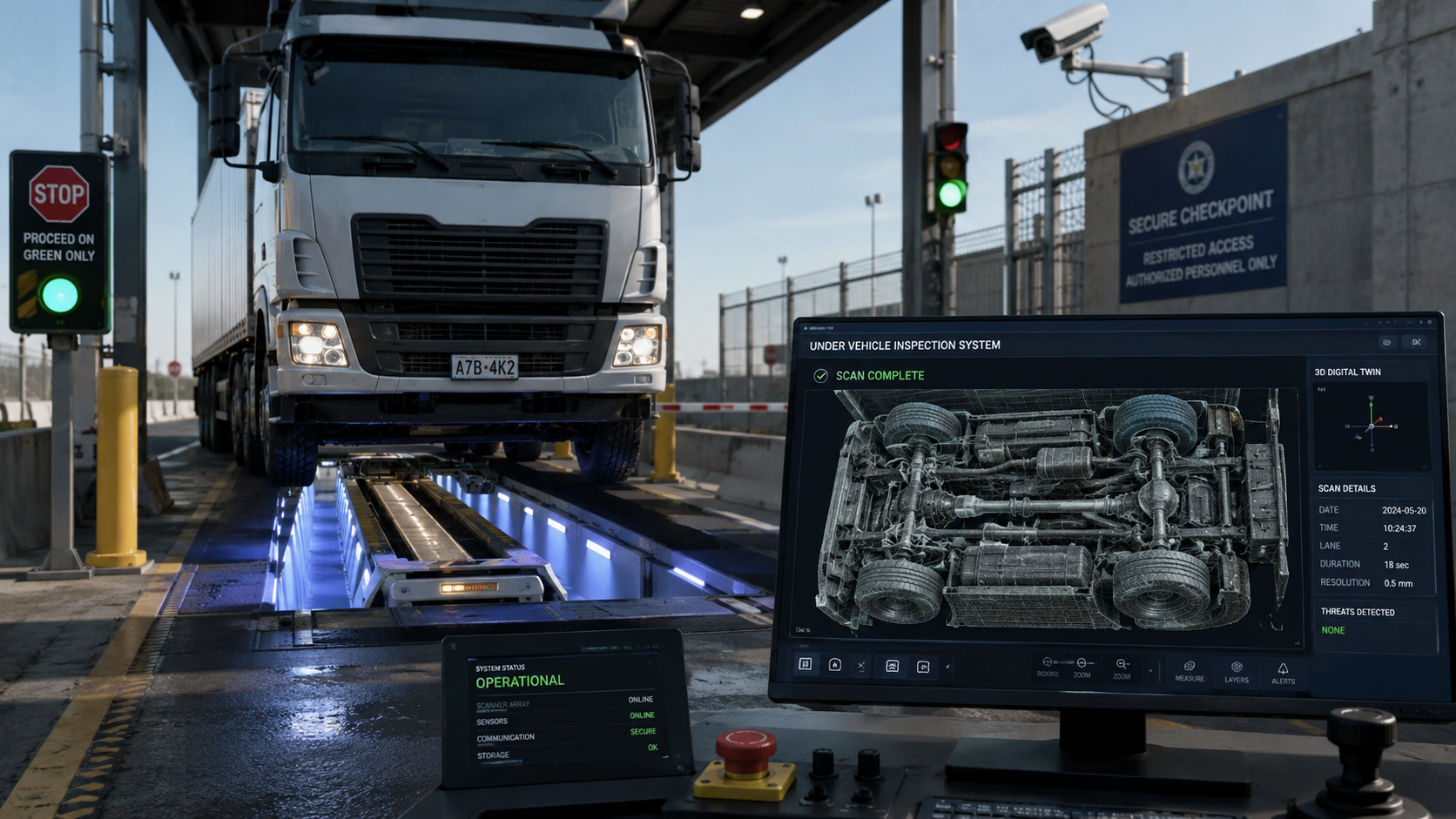
In the landscape of modern defense and infrastructure protection, the entry point is the most critical link in the security chain. For years, ground-level threats were monitored using basic mirrors and manual labor—methods that are now considered obsolete against sophisticated modern risks. To truly secure a facility in 2026, security directors are turning to the high security vehicle inspection system (UVSS). This technology provides a comprehensive, digital view of a vehicle’s most vulnerable area: the undercarriage.
At UVSS, as an expert reseller of globally recognized scanning hardware, we understand that “security” is only as effective as the data it produces. A high security vehicle inspection system acts as a digital sentry, ensuring that no vehicle enters your site without its underbody being fully analyzed for anomalies, explosives, or contraband. In this guide, we will explore the mechanics of this technology and answer the critical question for many procurement officers: how does a 3d under vehicle scanner work?
The Evolution of Undercarriage Inspection Technology
Traditional inspection methods were once limited by what the human eye could see in a reflection. Modern undercarriage inspection technology has changed the game by utilizing high-speed, high-resolution cameras that capture images as a vehicle drives over a scanning unit. However, a standard high security vehicle inspection system in the past only provided 2D images, which could be easily confused by shadows or complex mechanical parts.
The modern high security vehicle inspection system has evolved into an AI-powered UVSS. These systems don’t just take pictures; they analyze them. By utilizing deep-learning algorithms, an automated vehicle screening process can identify the specific make and model of a vehicle and compare its underbelly to a “perfect” factory-standard image. This ensures that even the smallest addition—such as a magnetic tracker or a disguised explosive device—is immediately flagged for the operator.
Understanding the Mechanics: How Does a 3D Under Vehicle Scanner Work?
For technical security integrators and facility managers, understanding the “how” is just as important as the “why.” So, how does a 3d under vehicle scanner work in a real-world scenario?
Unlike 2D systems that stitch together a flat strip of images, a 3D scanner utilizes stereoscopic imaging or structured light technology. To explain how does a 3d under vehicle scanner work, imagine two cameras positioned at different angles (similar to human eyes). As the vehicle passes over the unit, these cameras capture the underbody from multiple perspectives simultaneously.
- Depth Perception: The system calculates the distance to every point on the chassis, creating a volumetric “point cloud.”
- Shadow Elimination: Because the cameras see from multiple angles, they can “look around” obstructions like exhaust pipes or fuel tanks that would normally cast shadows in a 2D scan.
- Digital Twin Creation: This data is processed in milliseconds to create a high-definition 3D model. When you understand how does a 3d under vehicle scanner work, you realize that the operator can rotate and zoom into this digital model, inspecting the vehicle from angles that were previously impossible to reach.
Why Invest in a High Security Vehicle Inspection System?
Choosing a high security vehicle inspection system is a strategic move for any high-value target, such as an embassy, airport, or data center. As a reseller, we often highlight that the true value of a high security vehicle inspection system lies in its ability to provide vehicle threat detection without slowing down traffic.
A high security vehicle inspection system is designed for high-throughput areas. Because it is a drive-through solution, there is no need for the vehicle to stop, which prevents “gate congestion”—a common vulnerability that attackers often exploit. By integrating automated vehicle screening with license plate recognition (ANPR), you create a complete security profile for every vehicle on your property.
AI-Powered UVSS: The Future of Automated Vehicle Screening
The transition to an AI-powered UVSS is the most significant advancement in recent years. Manual inspection is prone to fatigue and human error; a guard might miss a small package taped to a dark corner of a truck frame. An AI-powered UVSS, however, never gets tired.
This automated vehicle screening software performs a “change detection” analysis. If a car enters a government parking lot every day, the high security vehicle inspection system remembers its “fingerprint.” If that car returns with a foreign object attached to the axle, the vehicle threat detection software triggers an instant alarm. This level of automation is why a high security vehicle inspection system is considered a force multiplier for security teams.
Sector-Specific Applications of the High Security Vehicle Inspection System
At UVSS, we supply a wide range of industries with these solutions. Every sector has unique requirements, but all benefit from the hardened perimeter a high security vehicle inspection system provides:
- Military and Border Control: Where vehicle threat detection is a matter of national safety, these systems provide a non-intrusive way to scan for weapons and smuggled goods.
- Government Buildings: Implementing a high security vehicle inspection system ensures that diplomatic and administrative hubs are protected from VBIED (Vehicle Borne Improvised Explosive Device) threats.
- Logistics and Warehousing: For high-value distribution centers, undercarriage inspection technology prevents theft by ensuring that inventory isn’t being smuggled out attached to the underside of delivery trucks.
Why Partner with UVSS for Your Security Needs?
As a dedicated reseller of the world’s most advanced undercarriage inspection technology, UVSS provides more than just hardware. We provide the expertise to ensure your high security vehicle inspection system is integrated perfectly into your existing security stack.
We help our clients understand the technical nuances, such as how does a 3d under vehicle scanner work in extreme weather conditions or how to optimize AI-powered UVSS algorithms for specific vehicle types. Our goal is to ensure that your investment in a high security vehicle inspection system translates into absolute peace of mind.
Conclusion: Securing the Unseen
The space beneath a vehicle is no longer a hiding place for threats. With a modern high security vehicle inspection system, the invisible becomes visible. By combining automated vehicle screening with the depth-perception of 3D technology, you are closing a critical gap in your facility’s defense.
Now that you know how does a 3d under vehicle scanner work and why an AI-powered UVSS is essential for 2026, the next step is implementation. Don’t wait for a security breach to reveal the weaknesses in your perimeter.
Contact UVSS today for a consultation and customized quote on the highest-performing vehicle inspection systems in the industry.
Leave a Reply